Online Course
Architectures of Change:Introduction to Practical Political Organizing
Hosted by The Left Berlin & Reincantamento
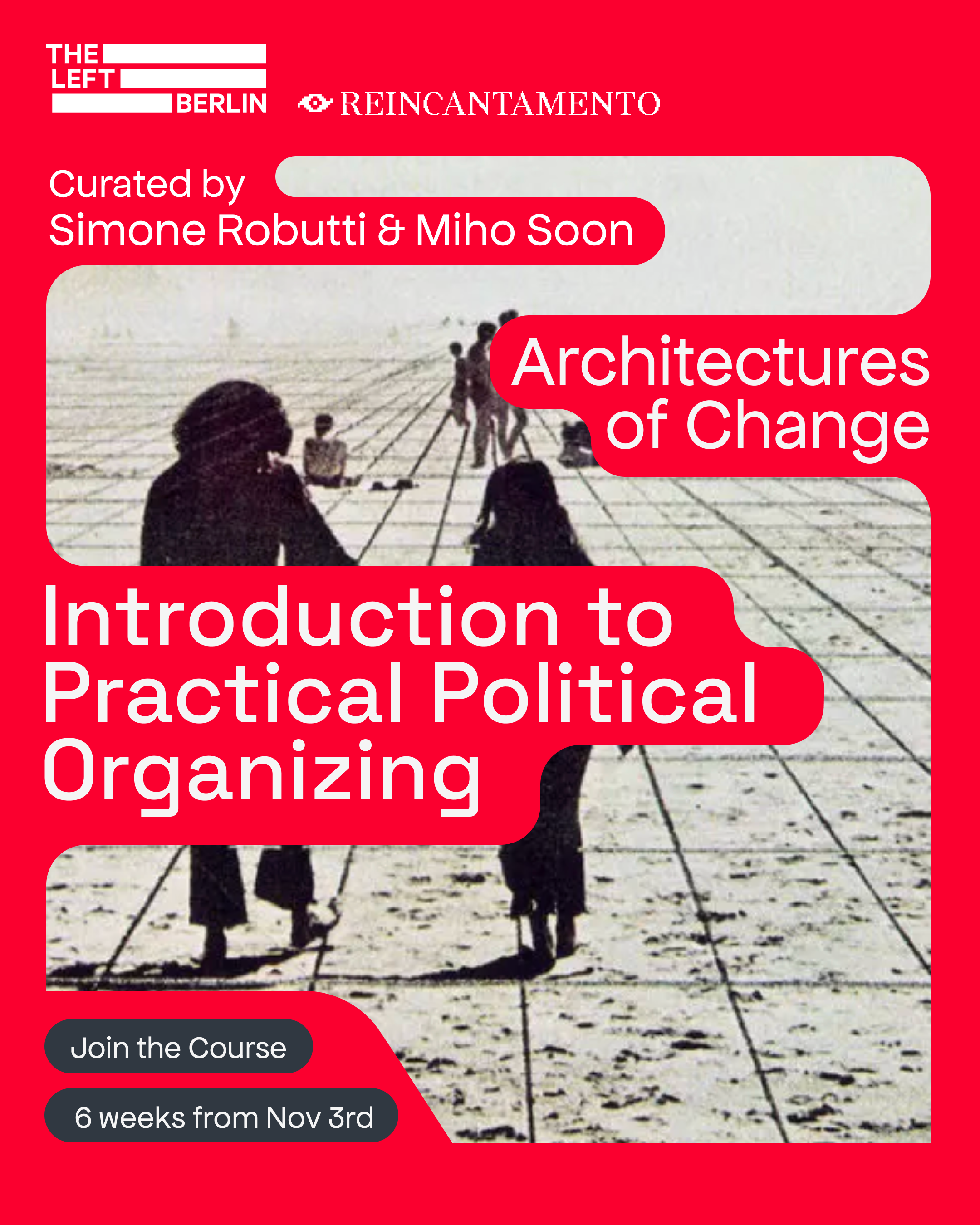
Winter 2026 Cohort
Starting November 3rd, 2026
Every Tuesday, 18:00-20:30 CET
20:00-22:30 (Arabian Standard Time)
12:00–14:30 (ET)
09:00–11:30 (PT)
Course Duration: 6 weeks
From endless protests that go no where, infighting and planeries that never needed to happen - there are skills, frameworks and ideas on how we can be better organizers. There are many strategies when it comes to building power, facilitating meetings, strategizing our theories of change or managing money. But most organizers never learn this kind of practical political education
Whether you don’t know where to start or want to break out of ineffective forms of organizing, Architectures of Change will provide you with the practical and conceptual tools necessary to build effective political organizations.

Who is this course for?
Anyone who is interested in political organizing. Our former participants have been people who have an interest in politics but have never applied it, or come from a wide range of movements: Anti big tech, workers’ rights, the Palestine solidarity movement, alternative economics, climate & beyond.
This course is for:
Beginners with no experience in active politics
Frustrated and disappointed veterans
Aspiring builders of a better tomorrow
Module Breakdown
The course is structured around nine module topics that span throughout 6 classes. Each class is 2.5 hours, moving between conceptual and practical. All classes are held on Zoom.
Module 1: Power
We will start by building a shared vocabulary to think and talk about power, strategy, and change. We will explore a new grammar that better explains how our society changes and how we can be an active part of such a process.
Module 2: Organizations as Systems
Module 2 will present foundational concepts of systems thinking applied to political organizations. The goal is to think in a rich and structured way about movements, political ecosystems, and our role in them. We will also rethink the concept of Leadership in light of a systemic perspective.
Module 3: Organizational Design
Organizations must be designed to be effective. In this module, we will go through all the different elements of an organization that can and should be designed to achieve our political goals.
Module 4: Leadership
Leadership is what makes organizations and political ecosystems move in a coherent direction. We will learn about different forms of leadership that go beyond the simple authoritarian command structure or complete flat hierarchy, and reflect on how to embody different and empowering forms of leadership.
Module 5: Facilitation
We will acquire practical knowledge of how to handle one of the most common processes in every organization: meeting organization and facilitation. In the second half, we will reflect on the more emotional side of participating in political organizations: motivation, conflict, and agency.
Module 6: Conflict
Organizations are made of people: ignoring the psychological and inter-personal aspects of organizing is a recipe for failure. In this module, we will learn theory and practical methods to resolve conflicts.
Module 7: Money
Talking about and managing money can be difficult in organizing spaces, because money brings up many tensions very quickly. In this module we explore common dynamic patterns about money in organizing and what alternative financial models are out there for resourcing organizations and handling it.
Module 8: Process Design
Designing, documenting and implementing a process is the foundation to scale any organization while enabling participation. We will learn with a practical example how to start establishing strong processes in your organization.
Module 9: Governance
In this module, we will understand better how organizations make decisions and how to shape decision-making systems and culture. We will go over a simple governance model you can adopt right away, and also use it to reflect about organizational tensions.

What participants have said about the course
"The instructors on this course were clearly incredibly passionate about what they do, and really effectively pass on that to the participants - the potential for change if we really collectivize and be proactive about it, and the nuances of what change means.
I acquired a lot of new knowledge about a field I’m already deeply engrossed in, expanded my vocabulary for it as well - and humbly learned that whatever I’m trying to do, someone has tried before and done it better and left some sort of guide behind. So I don’t have to do this blind! I also felt like my politics and identity were both considered and protected, which is something I don’t take lightly in today’s world.”
Participant in Berlin, Germany
"I learned a lot in the course, especially in terms of new frameworks of thinking and knowledge about things I did not know existed at all. Now I can go deeper into the topics and read the great recommended readings. Still, I find the general atmosphere, the instructors, and the participants to be the best part of the course. It genuinely made me feel more inspired and helped me see some alternatives to the existing structures around me. Each one-to-one exercise was also very exciting and enjoyable."
Participant in Berlin, Germany
“I almost didn't join this course because I was worried I wouldn't have the mental space for it, but I'm really glad I did in the end. Within just a few months, I've already found applying the concepts and frameworks from the course incredibly helpful in so many different contexts. It was a really useful puzzle piece in making sense and naming what was not working in organisations I was in, and what would actually be useful instead."
Participant in The Netherlands
Hosts of the course

Simone Robutti
Host
Simone is an organizational developer and educator from Italy. Coming from a STEM background, he eventually moved into more organizational and political roles which he has a decade of experience in. His main political experience is within Tech Workers Coalition, a worker-run International organization building worker power in the tech sector. He’s also currently active in Reversing.works, a technical investigation group revealing evidence of illicit worker surveillance through mobile app analysis, and Cables of Resistance, a major German anti-big-tech conference. He is based in Berlin.

Miho Soon
Co-Host
Miho is a researcher, facilitator, designer and coach from Malaysia. Her work focuses on political perspectives towards the human relationship with money and work. She has brought together hundreds of students, activists and organisations across Europe and Asia to talk about how personal experiences connect to a systemic context around capitalism. She has been active across degrowth, migrant justice, Palestine solidarity and tech movement spaces. She is the host of the documentary podcast Money Trauma, and an affiliate fellow of The Post Growth Institute. She's currently based in Berlin.
We also have a very limited number of free tickets, reserved for people who cannot afford it at all. Email us with the reason you'd like to participate in this and we'll get back to you!
Want to be notified when the course happens again in the future?
Can't make it this time? Architectures of Change will run again in 2027.
Sign up to receive an exclusive invitation to join the course.
FAQs
Write to us if you have more questions.
Do I need any active and practical experience to join this course?
No, you don’t. You can still engage with the course material with concepts you’ve seen on the sidelines or online.
Can I attend only some classes?
We generally prefer participants who can make the majority of classes, because they’re participatory, and concepts are sometimes built on top of the previous class. That being said, its okay if you have to miss one or two!
What happens if I miss a class?
We will send you a recorded class link on Zoom, and you can watch it before the next session.
Do you provide any certificates?
We can, on request.